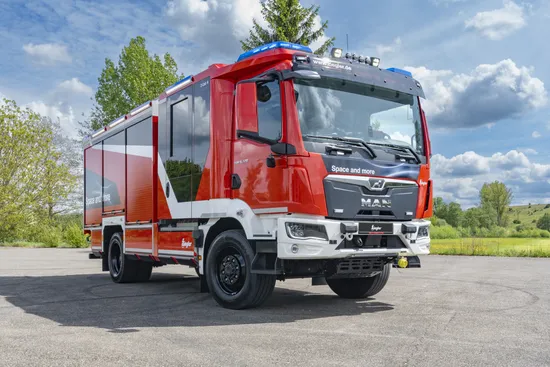
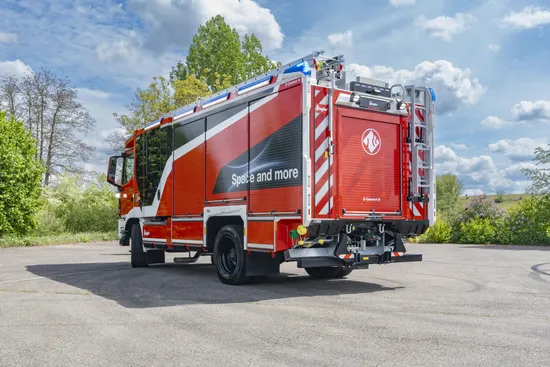
According to the motto #readywhenyouare, ZIEGLER will showcase its latest innovations for fire departments and emergency responders at INTERSCHUTZ 2026 in Hanover, occupying approximately 3,000 square meters of exhibition space. A central feature of the exhibition is the new HLF 20 XL, which sets new standards with its numerous innovative features.
With a total of 12 vehicles, modern pump and fire extinguishing systems, as well as intelligent components and digital solutions, ZIEGLER demonstrates how new technologies can be specifically applied to relieve the burden on emergency responders, reduce risks and make operations more efficient.
HLF 20 XL: well-designed spatial and technical concept
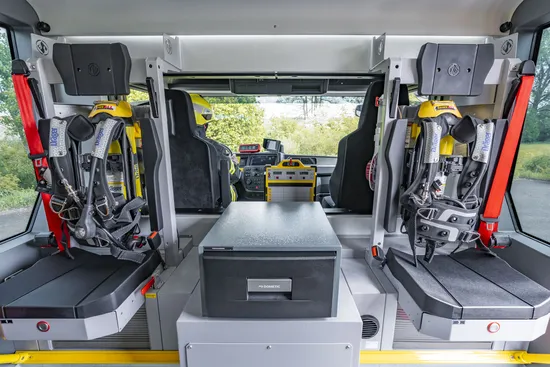
The HLF 20 XL features a Z-Cab XL crew cabin that is rigidly connected to the driver’s cab and offers a particularly large communication opening. In combination with the ZIEGLER standard seats, up to seven breathing apparatus stations can be accommodated – while still providing ample legroom. The exhibition vehicle also showcases practical equipment details such as an integrated refrigerated drawer for beverages. Displays in the vehicle offer a glimpse into future, more connected operational concepts.
Another focus is on safety and health: The vehicle incorporates systems that detect fires early and prevent them from developing. In addition, a disinfection system on the hygiene board ensures improved water hygiene during operations.
Z-Vision Side of the latest generation consistently complements the overall concept.
Z-Vision Side of the latest generation: Improved performance through optimized lighting
With Z-Vision Side of the latest generation, ZIEGLER presents an advanced lighting solution. An additional LED strip in the perimeter lighting provides significantly higher light output and improved illumination.
The larger illuminated area on the ground increases safety and efficiency during operation. The development is based on a scientific approach and enables a significant increase in light output: up to 5,000 lumens through combined light modules.
Robotics as an integral part of the vehicle
Modern emergency scenarios are increasingly presenting fire departments with complex challenges—such as fires, hazardous materials incidents or operations in hard-to-reach areas. As a result, drones, robotic systems and autonomous platforms are becoming increasingly important. ZIEGLER is responding to this trend by systematically integrating robotics technology into its vehicle concepts for the first time. The focus is not on developing proprietary robots, but rather on the well-thought-out and practical integration of existing systems into the firefighting vehicle.
The HLF 20 XL offers a comprehensive interface solution for this purpose: drones, tracked robots, or robotic dogs can be stowed, loaded, and operated directly within the vehicle. The systems are procured according to customer requirements and then fully integrated into the vehicle concept—from secure storage and charging infrastructure to central control.
The key advantage for fire departments: Robotics systems are ready for deployment at any time, without the need for additional trailers or separate logistics. At the same time, central operation enables simple and efficient use during missions.
The vehicle features specially integrated charging stations for drones as well as an innovative drone launch system. This allows drones to land directly on the vehicle and charge automatically.
Alternatively, the drone can be operated via a tethered solution and supplied with power simultaneously. This operating mode offers clear advantages, particularly in confined operational areas or in challenging terrain, as it ensures longer operational times and high operational reliability.
With this approach, ZIEGLER creates a practical platform on which modern robotics technologies are seamlessly integrated into existing operational concepts.
Different components, such as drones or robots, can be controlled via a common user interface without the need for separate controls or extensive training. This significantly reduces training requirements and provides lasting relief for emergency personnel in their daily operations.
Wide range of robotics solutions
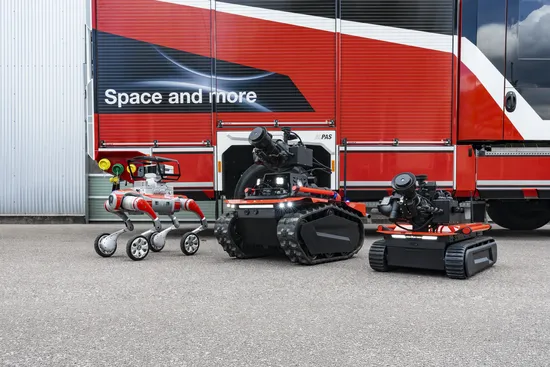
At INTERSCHUTZ, ZIEGLER showed various robotic systems designed for a range of application scenarios:
1. Z-Crawler 80
With the Z-Crawler 80, ZIEGLER presents a particularly compact solution for the rapid deployment of robotics in everyday firefighting operations. The robot weighs less than 80 kg and can be easily carried by two firefighters. Thanks to its compact design, it can be stowed directly in the equipment compartment of a firefighting vehicle – for example, in an ALPAS superstructure – and is thus immediately available without the need for an additional trailer.
Despite its small size, the Z-Crawler 80 boasts powerful operational capabilities. These include an integrated water cannon with a flow rate of approximately 1,000 l/min, a self-protection water curtain, and replaceable batteries for rapid continued operation.
A particular advantage lies in the system’s high modularity: sensors, cameras, or other payloads can be quickly swapped between different robotic platforms. This allows the equipment to be flexibly adapted to different operational scenarios.
With this approach, ZIEGLER does not view robotics as a replacement for emergency responders, but rather as a new tool within existing firefighting tactics – compactly integrated, quickly available and developed with practicality in mind for daily use.
2. Z-Crawler 250
The Z-Crawler 250 expands ZIEGLER’s robotics concept with a powerful yet flexible platform for demanding operational scenarios. Weighing approximately 250 kg and equipped with a water cannon capable of delivering up to 2,000 l/min, the system offers high firefighting performance in a compact design.
A key feature is its two-tier modular design. The payload can be changed in about one minute – for example, from a firefighting robot to a logistics platform with a smoke extraction fan or a hose transport module. This allows the robot to be flexibly adapted to different operational requirements.
The Z-Crawler 250 is used in particular in situations where there is an increased risk for emergency personnel. In the case of indoor fires, industrial fires, hazardous material incidents or in areas at risk of collapse, the robot can first enter the danger zone, provide situational information, and carry out initial measures while emergency personnel remain at a safe distance.
3. Four-legged robot dog Z-Scout
With the Z-Scout, ZIEGLER is expanding its robotics concept to include a highly mobile platform for reconnaissance and situational awareness. The four-legged robotic dog was specifically designed for operational environments that are difficult for tracked vehicles to access – such as steep stairs, rough terrain or building ruins.
Weighing approximately 30 kg and featuring an IP67 protection rating, the Z-Scout is designed for demanding operational conditions. Equipped with a dual-camera system comprising a thermal imaging camera and a daylight camera, as well as a gas detector, it enables safe reconnaissance of hazardous areas and provides critical real-time information to incident command.
Thanks to its high mobility, the robot is particularly well-suited for in-depth reconnaissance in complex operational situations. At the same time, it can be used as a communication relay, maintaining a stable connection between emergency responders and command centers even in difficult environments.
The Z-Scout is part of a connected robotics system in which drones, tracked robots and other platforms are controlled via a unified user interface and integrated into a common tactical network. Sensors and payloads can be exchanged modularly between the systems – for maximum flexibility in the field.
4. Drone with an automatic hangar system
ZIEGLER is introducing a new drone solution that seamlessly combines aerial and ground reconnaissance. The automatic hangar system can be integrated directly into the ALPAS superstructure and enables fully automatic landing and charging of common drones.
Thanks to a tethered power supply, the drone can hover for hours without interruption, while the integrated lighting module delivers up to 60,000 lumens at an altitude of 20–40 m. This ensures that even large operational areas are fully illuminated at night – without blind spots. Optionally, the drone can also take off via a pull-out cable system while being charged.
In combination with the ground robots, a complete situational picture emerges: While the drone monitors the scene from the air, the robots provide precise infrared data in thick smoke. The result for incident command: maximum clarity of information, confident decision-making, and precise operations without “information black holes.”
Connected systems for greater safety in the field
All of the systems presented are part of an integrated overall concept. Drones, tracked robots and other platforms are controlled via a unified user interface and integrated into a shared tactical network.
In particular, the systems handle high-risk tasks such as reconnaissance, surveillance or initial response in hazardous areas. At the same time, they provide real-time data that enables a well-informed assessment of the situation.
ZIEGLER does not view robotics as a replacement for emergency responders, but rather as targeted support. The technology helps minimize risks, improve situational awareness and make operations safer and more efficient.


